Most people never question the height of their desk until their shoulders, wrists or neck start to complain. Desk height matters more than almost any other part of a home office, because it sets the position of your arms for hours at a time. Here's what "standard" means, why it doesn't fit everyone, and how to find the height that fits you.
Desk height calculator
Enter your height for a starting point. Fine-tune from there so your elbows sit at about 90 degrees.
Estimates based on average body proportions, measured from the floor to the top of the desk. Shoes, chair padding and keyboard trays change the numbers by an inch or so.
What is the standard desk height?
Most desks sold for homes and offices are 28 to 30 inches (about 71 to 76 cm) from the floor to the top of the desk. 29 to 30 inches is the most common height you'll see on product listings. That range was set long ago for a person of about average height, sitting in a chair with the seat around 17 to 19 inches high.
The problem is that people aren't average. A desk that suits someone who is 5 ft 10 in can be too high for someone who is 5 ft 3 in and too low for someone who is 6 ft 3 in. That's why the right height for you matters more than the standard.
How to find the right sitting desk height
The goal is simple: when you type, your elbows should be bent at about 90 degrees, your shoulders relaxed and your wrists straight.
- Set your chair first. Adjust the seat so your feet rest flat on the floor and your knees are about level with your hips.
- Let your arms hang, then bend your elbows to about 90 degrees.
- Measure from the floor to the underside of your forearms. That's roughly where your keyboard should sit, so the top of your desk should be at that height or a little lower.
If your desk is too high and can't be lowered, raise your chair and add a foot rest so your feet stay supported. If it's too low, raise the desk with sturdy risers, or consider a standing desk that adjusts to any height.
Desk height by your height
These are starting points for a sitting desk, based on typical body proportions. Use the calculator above for your exact height, then fine-tune.
| Your height | Sitting desk height | Standing desk height |
|---|---|---|
| 5 ft 0 in (152 cm) | about 24 in (61 cm) | about 38 in (96 cm) |
| 5 ft 4 in (163 cm) | about 25.5 in (65 cm) | about 40.5 in (103 cm) |
| 5 ft 8 in (173 cm) | about 27 in (69 cm) | about 43 in (109 cm) |
| 6 ft 0 in (183 cm) | about 29 in (73 cm) | about 45.5 in (115 cm) |
| 6 ft 4 in (193 cm) | about 30.5 in (77 cm) | about 48 in (122 cm) |
Notice that most people under about 6 ft end up below the 29 to 30 inch "standard". That's why so many people feel their desk is slightly too tall.
What height should a standing desk be?
The same 90-degree elbow rule applies when you stand. With your shoulders relaxed and elbows at your sides, the desk surface should sit at or just below your elbows. For most adults that's somewhere between about 38 and 48 inches.
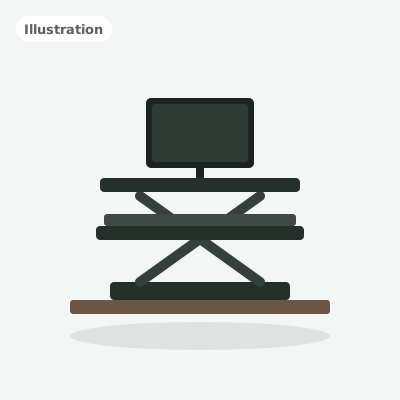
Look for a standing desk or converter whose height range covers both your sitting and standing numbers. Our standing desk guide lists each desk's range, and our converter guide covers options that sit on top of the desk you already have.
Don't forget your monitor
Getting the desk right only solves half the problem. The top of your screen should sit at about eye level, roughly an arm's length away. See our guide to proper monitor height for the details.
Quick fixes if your desk is the wrong height
- Desk too high: raise your chair and add a foot rest, or use an under-desk keyboard tray to bring the keyboard down.
- Desk too low: add furniture risers under the legs, or put the monitor on a stand so you don't hunch.
- You share the desk: an adjustable standing desk or a converter lets each person set their own height.